Finding a job is not just about filling out applications – it is about finding the right vacancies that match your skills, work experience, qualifications, salary expectations and job preferences.
There are many job seekers who go through the job search process mindlessly and end up wasting their time on irrelevant job offers because they have not taken the time to analyze the requirements of the position.

The key to a successful job search is to come up with a strategy when looking for jobs to apply for. You need to take the time to understand the requirements of the position, cross-check these requirements with your resume and see if they match your career objectives before you waste your time on a meaningless application.
When I am sourcing jobs for my candidates, I always take the time to understand the basic requirements of a job vacancy before recommending it to my clients. I believe that a relevant application should begin with an analysis of a candidate’s experience and skills in comparison to the requirements of a job vacancy and not the other way round. In my practice, I have come up with the following tips on how to find relevant jobs to apply for and will share them below with you.
In this post, I will share 7 simple tips on how to find relevant jobs to apply for with examples and a job application checklist to help you identify the right vacancies to apply to.
Why Should You Identify Relevant Jobs Before Applying?
A targeted job search can help a person put more effort into opportunities that are right for his or her background rather than wasting time applying to random positions.
Before applying, you should consider:
- Job requirements: Does the position require skills, experience or qualifications you possess?
- Relevant experience: Have you performed similar activities in a previous position?
- Required skills: Do you meet the technical and transferable skill requirements?
- Experience level: Does the vacancy match your level of expertise or stage of career?
- Location and work arrangement: Location and work arrangement: Does the position match your remote, hybrid or on-site preferences?
- Salary expectations: Does the advertised payment satisfy your minimum requirements?
- Application requirements: Can you provide required documents, certifications and other information?
These checks help one narrow down job searches and prepare a resume that meets the hiring company’s expectations.
Step 1: Define Your Job Search Criteria
Before hitting the job boards, determine the types of positions you want to pursue. If you do not have clear criteria for your vacancy search, it can be easy to get distracted by appealing opportunities that do not align with your experience.
Define the following:
- Target job titles: Your preferred roles and reasonable alternatives that carry similar day-to-day responsibilities.
- Industry: Industries in which your skills and experience are relevant.
- Experience level: Whether you target entry-level, associate, mid-level, senior, or managerial positions.
- Location: Preferred countries, cities, or regions.
- Work arrangement: Remote, hybrid, or on-site.
- Salary range: Your minimum salary where compensation information is available.
- Essential skills: The technical competencies, certifications, qualifications, and experience that you can demonstrate.
For instance, a candidate targeting Data Analyst positions may want to find Data Analyst, Junior Data Analyst, Reporting Analyst, or Business Intelligence Analyst vacancies. However, every alternative should be assessed individually since job titles do not always represent the same responsibilities.
I use this type of criteria-based approach when narrowing down my job opportunities. It creates a reference point for assessing whether a vacancy is worth pursuing.
Practical tip: Keep your target criteria in a Google Sheet. You can update it as your career goals evolve and use it to evaluate every new job opening.
Step 2: Read the Complete Job Description
One of the most important actions when finding relevant jobs revolves around reading the complete job description before applying.
A job title does not provide all the information you need to know if a role aligns with your experience and targets the skills that a particular vacancy prioritizes. Two companies may use the same job title but request drastically different technical skills, responsibilities, qualifications, and years of experience.
While reviewing a job posting, keep the following in mind.
Job Responsibilities
Look at what tasks the role requires you to complete. Compare them to your previous responsibilities, projects, and achievements.
For instance, a Data Analyst vacancy may involve preparing reports, analyzing datasets, building dashboards, and communicating to stakeholders. A candidate with reporting, Excel, SQL, and data visualization experience fits the job better than someone whose experience sits in general administrative support.
Required Qualifications
Check whether the employer requests specific degrees, certificated, licenses, or education.
Certain qualifications are always essential, whereas others are preferred. Instead of assuming that every single qualification carries equal importance, read the wording to understand which ones are non-negotiable.
Required Experience
Review how many years of experience and what sort of experience the employer wants.
If the vacancy requests five years of specialized experience but a candidate only has two years of relevant work, it may not be worth pursuing. On the other hand, if the experience requirement states that years of specialization are preferred, the candidate may want to reconsider their application.
Technical and Transferable Skills
Examine what technical proficiencies and transferable skills the job requires or prefers.
They often take the shape of software, tools, methodologies, and soft skills such as SQL, Python, Microsoft Excel, Salesforce, project management, stakeholder communication, analytical thinking, and problem-solving.
Prioritize the skills that seem crucial for the actual responsibilities of the role.
Step 3: Compare the Job Requirements With Your Resume
After understanding the vacancy, compare the employer’s requirements with the information you have in your resume.
This is the point at which a structured job-matching process comes in handy.

I have used this strategy as a candidate when reviewing job opportunities. I compare the job description with the candidate’s resume, determine the areas in which the candidate aligns best with the post, and highlight essential areas of misalignment before prioritizing the application.
For instance, let us say that a candidate is considering a Business Analyst position.
The job requires:
- Requirements gathering
- Stakeholder communication
- SQL
- Process documentation
- Reporting and analysis
The candidate’s resume demonstrates requirements gathering, communication with stakeholders, Excel reporting, and process documentation, but not SQL or relevant SQL experience.
They have several relevant qualifications, but there is also a potential skills gap.
| Job requirement | Evidence in the resume | Assessment |
| Requirements gathering | Documented stakeholder requirements | Strong match |
| Stakeholder communication | Coordinated with business teams | Strong match |
| SQL | No demonstrated experience | Gap to investigate |
| Process documentation | Created process documents | Strong match |
| Reporting and analysis | Prepared Excel reports | Partial or strong match, depending on the role |
This comparison provides the candidate with a realistic assessment of the opportunity.
If SQL is essential and the candidate has never used it, they should not demonstrate that skill on their resume. They can decide if their other qualifications justify a job application or if a different vacancy would be a better fit.
The objective of this assessment is to determine genuine alignment, not to make every job appeal.
Step 4: Identify Important Keywords in the Job Description
Keywords help you to understand what vocabulary an employer wants to see in your resume, portfolio, or application. They are also essential if you are tailoring your resume for an applicant tracking system (ATS).
An applicant tracking system is a software that some employers use to manage their recruitment needs. Different ATS tools and employers use different screening and evaluation methods, so there is no universal ATS score or formula that guarantees an application will pass screening.
To identify relevant keywords, review the job description and look at the recurring or important terms in the responsibilities, qualifications, and required skills sections.
Some common sets of terminology consist of:
- Technical skills: SQL, Python, Microsoft Excel, Salesforce, Jira, Power BI, data analysis, software testing.
- Functional skills: Project management, requirements gathering, quality assurance, reporting, process improvement, customer relationship management.
- Professional skills: Communication, problem-solving, collaboration, analytical thinking, time management.
- Qualifications: Bachelor’s degree, professional certification, industry-specific license, or relevant years of experience.
The most important keywords depend on the position. A QA Engineer vacancy may highlight test automation, regression testing, API testing, and defect tracking, whereas a Project Manager vacancy would center around project planning, risk management, stakeholder management, and delivery.
How to Use These Keywords
- Identify the essential skills and qualifications from the job description.
- Check which of those skills are supported by your real-world experience.
- Use terminology in your resume that reflects work you have genuinely performed.
- Demonstrate relevant examples in your work experience rather than simply listing keywords.
- Avoid claiming skills that you do not possess solely to appeal to a specific job description.
For instance, if a job posting requests “stakeholder management” and your experience centers around coordinating project updates with clients and internal teams, you may want to describe your experience using the employer’s terminology. However, if you have never used Python, you should not list Python as a professional skill simply because it has appeared in a job description.
An ATS-friendly resume should be clear, relevant, and truthful. It should help the recruiter understand your qualifications without relying on keyword stuffing.
Step 5: Check Location, Salary, Experience Level, and Work Arrangement
A job can match your technical skills but still be unsuitable because of its location, salary, working hours, or employment conditions.
Before applying, check the following.
Location and Remote Work
See if the vacancy is fully remote, hybrid, or on-site.
Depending on the location, a remote position may only be open to applicants that reside in a particular country, state, or region. Some employers also require specific working hours, occasional office visits, or business travel.
For instance, if you are targeting remote positions in the United States, a posting that requires candidates to reside in a specific state may not be suitable for someone that resides elsewhere.
Do not assume that a word such as “remote” means that you can work from any country.
Salary Expectations
Compare the advertised salary range with your minimum acceptable compensation.
Check whether the listing has a base salary, total compensation, commission, or an estimated range. If it is a contract, consider the hourly rate, contract duration, and expected workload.
If compensation has not been disclosed, decide whether the role is worth pursuing and whether you can clarify the range during the recruitment process.
Experience and Seniority
Review the required experience and compare it with your background.
A Senior Software Engineer position may request technical leadership, system design, and mentoring in addition to programming experience. A candidate that fulfills the programming requirements but has no leadership experience may only be suitable for a mid-level role.
Employment Conditions
Examine working hours, travel requirements, relocation expectations, contract type, and other conditions that affect your decision.
I recommend that you check all of these factors early on since they can determine whether a technically relevant job is actually practical for you.
Step 6: Research the Employer and Verify the Vacancy
Before applying, make sure that the employer and job vacancy are legitimate.
Start with the company’s website and careers page. When possible, confirm that the role is listed there and that the job title, location, and description are consistent with the posting.
You can also review the company’s LinkedIn presence and look for credible information about its business, products, and hiring team.
Pay attention to warning signs such as:
- Requests for payment to secure employment.
- Requests for sensitive financial information before a legitimate hiring process requires it.
- Unusually high salaries with vague responsibilities.
- Email addresses or websites that do not match the claimed employer.
- Pressure to share personal information through suspicious links.

A vacancy not being listed on a company’s website does not mean that it is fraudulent, since some employers use external recruitment agencies or job boards. When something seems unclear, verify it through an official contact channel before proceeding.
In particular for remote jobs, double-check where the employer has specified that you can work. Remote work policies can vary by country and region.
Step 7: Prioritize Jobs Using a Simple Job-Matching Checklist
After reviewing the job description, resume alignment, and practical conditions, determine which vacancies deserve your attention first.
A simple checklist can help you to compare the opportunities more consistently.
| Evaluation criterion | What to look for |
| Job title | Is the role relevant to your target positions? |
| Core responsibilities | Have you performed similar tasks? |
| Essential qualifications | Do you meet the mandatory requirements? |
| Technical skills | Can you demonstrate the important skills? |
| Experience level | Is your background suitable for the position? |
| Location and work arrangement | Does it fit your preferences and eligibility? |
| Salary and conditions | Are they acceptable? |
| Application status | Is the job still open, and can you submit an application? |
You can use this checklist in combination with a Google Sheets job application tracker. Some suggested columns consist of:
- Company name
- Job title
- Job posting URL
- Date posted
- Date discovered
- Location
- Work arrangement
- Salary range
- Required skills
- Matching qualifications
- Skills gaps
- Application deadline
- Job-match assessment
- Application status
- Follow-up
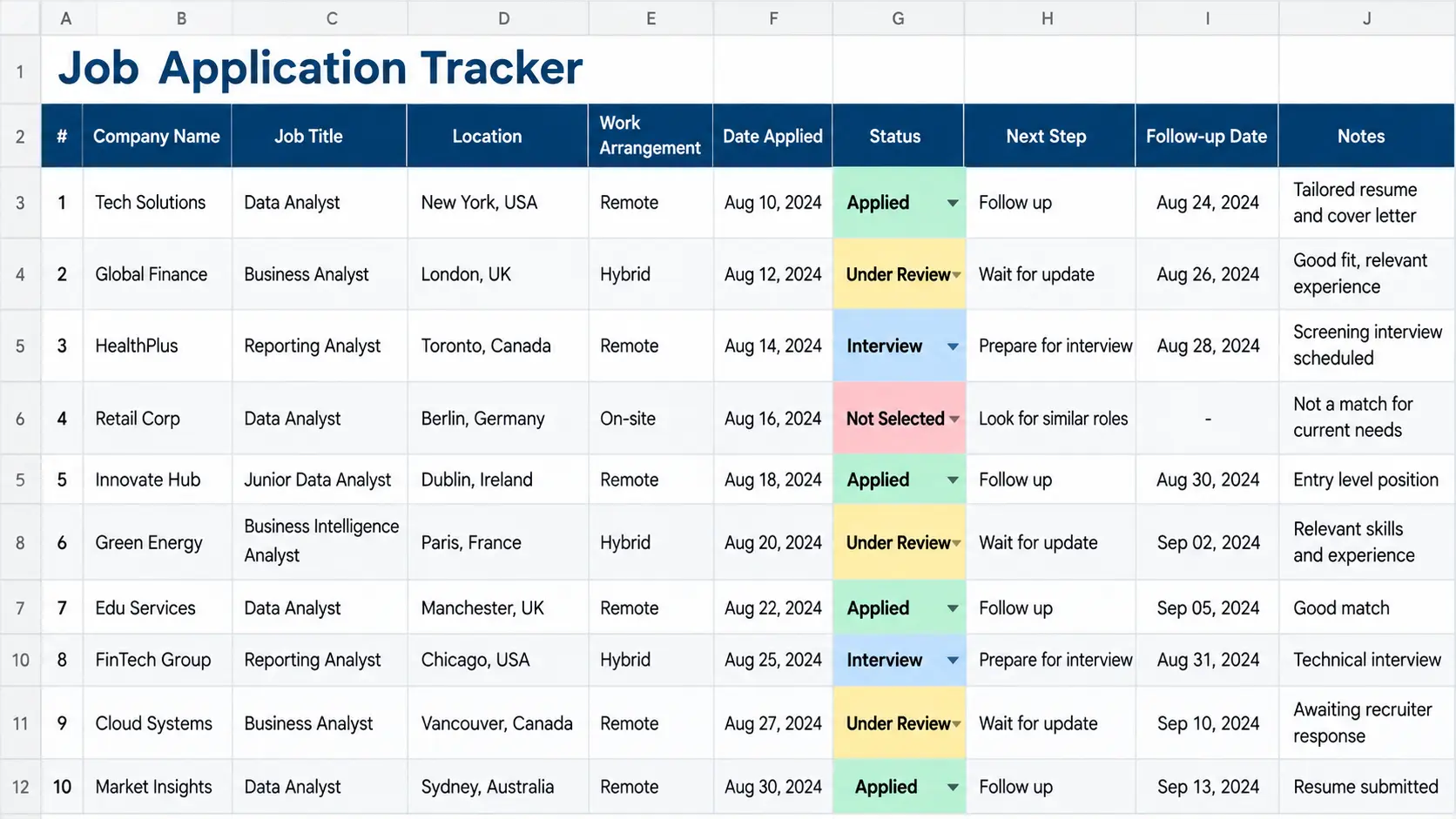
This information makes it easier to compare job openings and avoid submitting applications for the same vacancy multiple times.
Should You Apply a Job-Match Percentage?
You can use a personal match score to prioritize jobs, but treat it as a decision-making aid rather than an official ATS score.
For instance, you could rate core skills, relevant experience, qualifications, and practical requirements against a consistent checklist. A role that strongly matches your background and essential conditions may score higher than one with several major gaps.
However, a numerical score cannot guarantee that an employer will shortlist you. Recruiters may consider factors that are not obvious in the job description, and employers have different selection criteria.
A good match assessment should explain why a position suits you and identifies important gaps. The number is secondary.
A Practical Example: Choosing Between Two Jobs
Imagine that a candidate is looking for remote QA Engineer positions.
Job A: QA Engineer
- Requires API testing and regression testing.
- Asks for three years of software testing experience.
- Allows remote work within the candidate’s eligible location.
- Includes responsibilities similar to the candidate’s previous work.
Job B: Senior QA Automation Engineer
- Requires extensive automation framework development.
- Asks for five or more years of specialized experience.
- Involves technical leadership responsibilities.
- Requires occasional on-site attendance that conflicts with the candidate’s preferences.
Even though both roles have “QA Engineer” in their title, Job A appears to be more suitable based on the available information.
The candidate should still verify the job descriptions and essential requirements before applying. This example illustrates why it is beneficial to match responsibilities and conditions rather than just focusing on job titles.
Common Mistakes to Avoid When Finding Relevant Jobs
Applying Based on the Job Title
Read the responsibilities and requirements. Similar titles can represent vastly different job functions.
Ignoring Mandatory Qualifications
Review essential certifications, licenses, education, location restrictions, and required experience before spending time on an application.
Using the Same Resume for Every Vacancy
A generic resume may not highlight the most relevant experience for a specific role. Tailor it truthfully to focus on the most relevant qualifications.
Adding Keywords Without Evidence
Keyword stuffing in a resume is not useful if you cannot substantiate the skills. Only include the keywords for skills that you can demonstrate.
Ignoring Salary and Working Conditions
A role may be professionally relevant but unfitting due to compensation, working hours, relocation, or travel requirements.
Failing to Check Whether a Job Is Still Open
Review the posting date, application deadline, and current status. Where possible, verify the vacancy through the employer’s careers page.
Applying Without Tracking Your Progress
A job application tracker helps you to remember which roles you have reviewed, applied to, and need to follow up on.
Final Thoughts
Identifying relevant jobs before applying represents an important component of a successful job search strategy. Instead of focusing on quantity, compare your vacancy findings with your skills, qualifications, and experience, salary expectations, and preferred working conditions.
I have used this strategy in job-sourcing work to assess opportunities against candidate resumes and target criteria. Reviewing the job description first, identifying relevant skills, and checking essential requirements makes the selection process structured and purposeful.
Start by defining your target roles, reviewing complete job descriptions, comparing the requirements with your resume, checking the employer and working conditions, and recording suitable vacancies in a job application tracker.
The goal is not to apply for every job you find. It is to identify opportunities in which you can genuinely demonstrate a match and create a relevant, well-supported application.